
The part of the world that we now call Canada lies on the far side of the Atlantic Ocean. The cold waters around Canada are full of fish, and for centuries ships sailed from Europe to catch them. Whales and seals also live in this part of the world and were caught for their fat, which became a fuel for lighting homes and for cooking.
Story of the Lost brig Elizabeth Jane first draft version continued... ...and in progress.

WolframAlpha meets Elizabeth Jane
The WolframAlpha Search engine was launched recently. It might offer some interesting insights into the loss of the Elizabeth Jane and other ships. Her crew appear to have abandoned her on the evening of Saturday 8th July 1854. They were picked up by another ship and taken to Bridlington. A search for 'tides, whitby, 9th July 1854' with the WolframAlpha engine reveals (if it's accurate) that the sun set on the Saturday 8th July at 8.37 pm and rose the next day at 3.38 am. The engine shows that the second high tide on the Saturday was at 2.03 pm and the following low tide was at 8.29 pm. The information it provides about sun, moon and tides, makes it possible to more knowingly imagine the ways and circumstances in which Elizabeth Jane might have come ashore, been unloaded, broken up, and her remains taken back to Robin Hood's Bay.
Yet another Collina!
Like buses, you wait a lifetime; then two, and then a third comes along. First Read's Collina/Colina, then the Bideford Collina, and now the Penzance Collina. From the records of English Heritage we read of the wreck of an English cutter which in 1871 caught fire following an explosion of her petrol cargo caused by a collision with another vessel which ignored instructions forbidding any other vessels to moor nearby. She was a sailing vessel, constructed in 1860 of wood with iron bolts. See Collina at English Heritage's 'PastScape'.
What did an early 19th century Nova Scotian brig look like?
I'm still hoping to find a drawing/plan of a brig of the type built in Nova Scotia in the early part of the 19th century. I need enough detail to be able to accurately visualise its construction so I could 'make it'; perhaps in a computer. Can anyone help?
The Case of the Two 'Collinas'
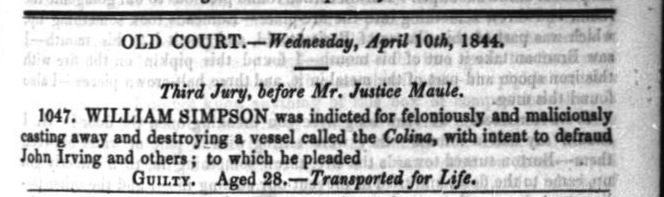
I have been busy this week finding out what I can about William Read's Colina. I was surprised to find, when reading Hugh Moffatt's Ships and Shipyards of Ipswich, that he spelt the name of Read's deliberately-sunk ship as 'Collina', not 'Colina' as it appeared in the Nautical Magazine's 1844 account of the trial of William Read and the Colina's master, William Simpson. Hugh Moffat quoted from a number of local Ipswich sources such as the Ipswich Journal, so it seemed likely that his spelling would be right; so how did the High Court and the Nautical Magazine get the spelling wrong?
On-line searches found a brig called the Collina sailing between Canada and Bideford in Devon. At first she seemed, from the dates of her voyages, to be the ship that Read later bought, but further in the records I found this ship sailing the Atlantic when William Read already owned a 'Colina/Collina' at Ipswich. Later,
Gary Carroll of Canada pointed out that the Bideford Collina was lost on about the 16th November 1840, sailing from Prince Edward Island to Bideford. It is recorded that she 'drove ashore near London...' and '...the whole of her crew, except two, were drowned.'As Read's Colina/Collina was lost off Holland in 1841 they must obviously be different ships. At Google Books, a reference to Read's Collina (spelt 'Reed') shows that she was also built at Prince Edward Island, but in 1827. It is interesting, if confusing, that two ships could have been built in close proximity and be given the same name.
The Nautical Magazine's spelling 'Colina' could be explained by them transcribing speech, though they also made a mistake with the name of Read's lawyer, calling him 'Cobbs' rather than Cobbold', but how does this explain the use of 'Colina' in the printed version of William Simpson's indictment in official court records?
Frank Meadow Sutcliffe - Agnes & Mary
Frank Meadow Sutcliffe's photograph of the brig Mary & Agnes has been added to the lostbrig.net site, courtesy of The Sutcliffe Gallery, 1 Flowergate - Whitby - YO21 3BA - 01947 602239
This image shows the Mary & Agnes at the mercy of pounding seas off Whitby in 1885. Though the Elizabeth Jane was lost in 1854, this photograph, together with George Weatherill's watercolours of lost brigs on the coast near Whitby, strongly evoke her loss. It is hoped that evidence might yet come to light that will give further insight into the loss of the Elizabeth Jane.
Will of William Read of Ipswich
The will of William Read, ship builder of Ipswich, has been obtained and is to be found on the lostbrig.net website. William Read left his book entitled 'Stalkard on Naval Architecture' to Ebeneezer Robertson his foreman. 'Stalkard' probably refers to Marmaduke Stalkartt's 'Rudiments and Rules of Ship Building Exemplified in a Series of Draughts and Plans with Observations Tending to Further Improvement of that Important Art.'
Subscribe to:
Posts (Atom)